Date Published: 30/06/2026
New AI smart buoys installed to keep watch over the Mar Menor
The high-tech devices will monitor the health of the Murcia lagoon’s water in real time
The
Mar Menor lagoon has a new set of eyes watching over it, with smart buoys now in place to monitor its condition in real time. It's one of the
most closely studied ecosystems anywhere in the world and the regional government, backed by state and European funding, keeps a constant check on its health so decisions can be made using solid scientific data rather than guesswork.
The infamous
"green soup" episode, marking its tenth anniversary this year, and the mass fish die-off caused by oxygen depletion back in 2019, are firmly things of the past that the authorities are determined not to repeat.
With that in mind, the Murcia regional government teamed up with the Polytechnic University of Cartagena to install a new network of smart buoys this week. Built by students from the university's Prisma research group, the devices use artificial intelligence to measure chlorophyll levels, turbidity, salinity and water temperature.
For the first time, they'll also track phycoerythrin, a red pigment found in certain microalgae and cyanobacteria, which helps predict eutrophication events caused by an excess of nutrients in the water. This works alongside chlorophyll readings to trigger early warning systems before problems take hold.
According to Juan María Vázquez, the Region's Minister of the Environment, all the data gets fed into digital twin models that provide a constant stream of information about the lagoon. He explained that the project sits under the "Think In Azul" national marine research programme, led by the Region of Murcia, which has received almost €10 million in investment in recent years.
Mr Vázquez also confirmed that assessments began this week on the shallow areas around the lagoon's entire perimeter, complementing the buoy data to build a fuller picture of conditions heading into summer.
He reported that the Mar Menor is currently stable, with
readings similar to this time last year, although salinity has crept up by around one gram per litre due to a wet winter sending more freshwater into the system. The biggest ongoing concern, he pointed out, remains the nutrient-rich water flowing in from the nearby aquifer and the Albujón ravine, which he described as acting like a river pouring roughly 150 litres per second straight into the lagoon.
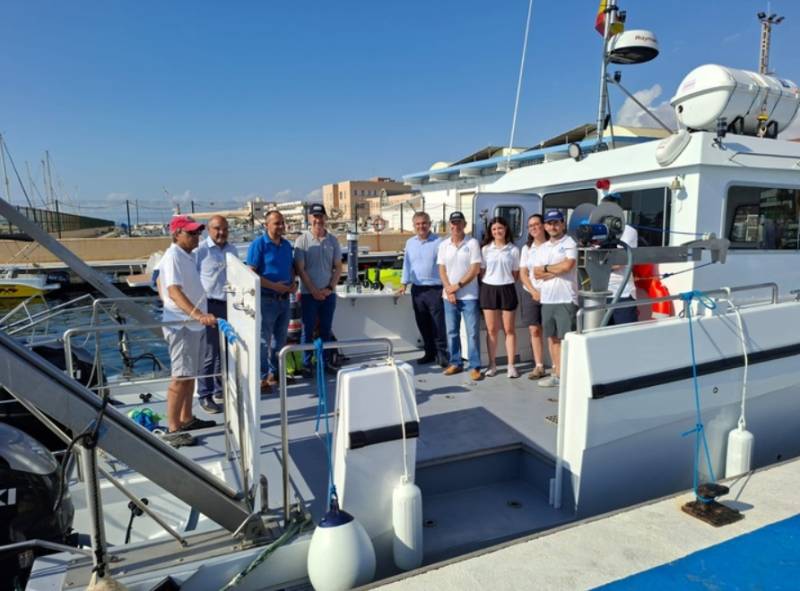
The buoys were launched from a research vessel based in Santiago de la Ribera, with an autonomous catamaran built by UPCT students used to track how each buoy moved through the water column.
Image: CARM
article_detail

|