Guidelines for submitting articles to San Pedro del Pinatar Today
Hello, and thank you for choosing San Pedro del Pinatar.Today to publicise your organisation’s info or event.
San Pedro del Pinatar Today is a website set up by Murcia Today specifically for residents of the urbanisation in Southwest Murcia, providing news and information on what’s happening in the local area, which is the largest English-speaking expat area in the Region of Murcia.
When submitting text to be included on San Pedro del Pinatar Today, please abide by the following guidelines so we can upload your article as swiftly as possible:
Send an email to editor@spaintodayonline.com or contact@murciatoday.com
Attach the information in a Word Document or Google Doc
Include all relevant points, including:
Who is the organisation running the event?
Where is it happening?
When?
How much does it cost?
Is it necessary to book beforehand, or can people just show up on the day?
…but try not to exceed 300 words
Also attach a photo to illustrate your article, no more than 100kb
PROPERTY SEARCH
PROPERTY SEARCH
article_detail
Date Published: 21/04/2026
Spain requests that EU cut trade ties with Israel
The Spanish Foreign minister headed to Luxembourg seeking support for suspending a key EU-Israel partnership
Spain is increasing pressure on the European Union to apply restrictions against Israel after the Spanish Minister of Foreign Affairs, José Manuel Albares, once again proposed at the EU Foreign Affairs Council this Tuesday April 21 that the European bloc suspend its association agreement with Israel or, at least, break it partially.
“The European Union is playing with its credibility,” he stated. “What more has to happen for the European Union to be moved?”
Over the weekend, President Pedro Sánchez – who has long been critical of the actions of the State of Israel – made his position clear, urging an end to the conflict and calling for restraint from Israeli leadership.
“I ask those who started this war to stop it and to rein in Netanyahu,” he said, adding that Spain remains a “friendly nation” towards Israel but does not support the actions of its current government.
The Spanish leader argued that any government seen to violate international law and core EU values should not maintain privileged ties with the bloc. “It is as simple as that,” he said, appealing to other member states to back Spain’s initiative.
However, the diplomatic reality within the EU means that the proposal is, once again, not being passed. Spain formally submitted the request last week alongside Ireland and Slovenia, but approval requires unanimous agreement among all 27 member states, a threshold that is rarely met on sensitive foreign policy issues.
The truth is that divisions within the bloc remain stark, particularly regarding the Middle East. Countries such as Germany have traditionally maintained strong support for Israel and are considered unlikely to endorse measures as far-reaching as suspending the association agreement. Other nations, including Italy, Austria, Hungary and Czech Republic, are also seen as reluctant to increase pressure on Netanyahu’s government.
Even measures with broad backing have proven difficult to pass. EU sanctions targeting violent Israeli settlers in the West Bank, for example, required extensive negotiation before gaining approval.
As an alternative, the proposal has been floated by several member states, including Spain, that the European Commission partially suspend the association agreement, focusing primarily on trade
This option would not require unanimity and can be adopted by a qualified majority, making it more politically feasible. In practice, it would mean placing higher tariffs on Israeli goods and a reduction in imports.
According to Commission sources, the proposed tariffs could affect Israeli exports to the EU worth around €5.9 billion, with an estimated cost impact of €227 million. It could be a powerful tool for reducing Israeli funds which can be used for its war efforts, largely because the economic relationship between the two sides remains asymmetrical. Trade with Israel represents just 0.8% of the EU’s total external trade, whereas the EU accounts for approximately 32% of Israel’s.
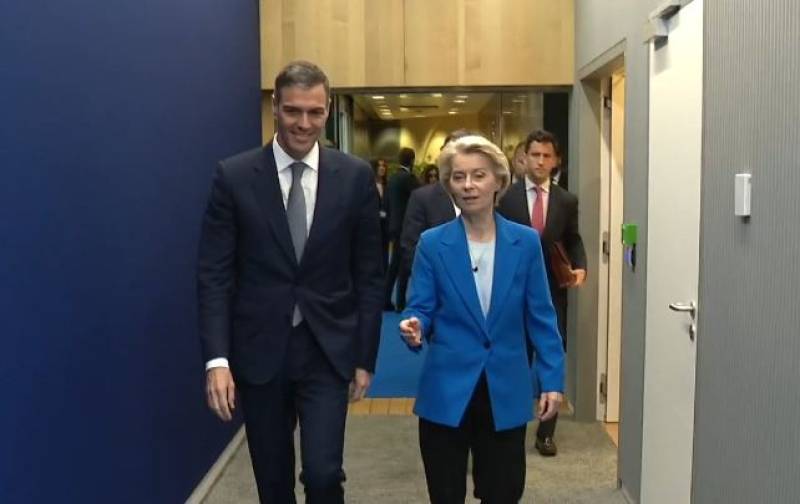
Image: Pool Moncloa/Carlos Herrero y Pool UE / 2025