


















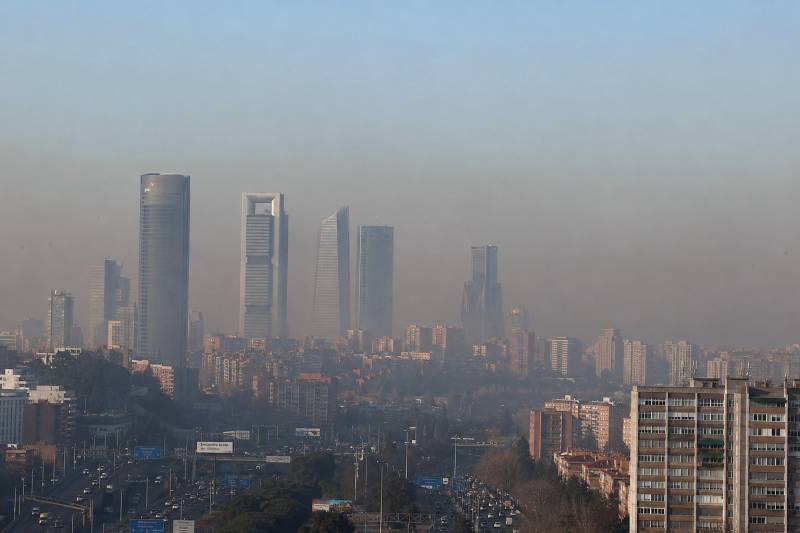
Around 33 million people in Spain, roughly two out of every three residents, were exposed in 2025 to air pollution levels that go beyond the new limits set by the European Union, according to a new report by the environmental group Ecologistas en Acción.
These stricter limits are due to come into force by 2030, but the findings suggest Spain is already struggling to keep up with them.
Even under Spain's current legal limits, which the report describes as outdated but still in force, around 9.1 million people were exposed to illegal levels of pollution. That's nearly one in five of the population.
Researchers say that this points to a long-standing failure in air quality policy, with pollution limits still being breached regularly almost 15 years after they were introduced.
If you go by the World Health Organization's guidelines, which are far stricter, then the picture becomes even more stark, virtually the entire population of Spain was exposed to unsafe air during 2025.
The report is based on data collected from 780 official monitoring stations across the country, including sites at airports and ports, grouped into 132 air quality zones.
It finds that pollutants such as fine particulate matter (PM10 and PM2.5), nitrogen dioxide (NO₂), and ozone continue to affect large parts of Spain, with alert thresholds for particles exceeded hundreds of times over the year.
While there has been some improvement in particulate pollution and nitrogen dioxide levels, partly thanks to cleaner vehicles, better fuels, and periods of strong winds and storms, the report highlights a worrying rise in ozone pollution.
Ozone levels reached their highest point since 2015, returning to pre-pandemic levels. During the heatwaves of July, August and September alone, there were 308 breaches of information thresholds.
The organisation warns that ozone is particularly dangerous because it is highly oxidative and can worsen respiratory and cardiovascular conditions. It also notes that it is increasingly affecting rural areas as well as cities.
The report links the rise in pollution in 2025 to climate change and increased fossil fuel use. Record summer temperatures and repeated heatwaves helped drive up ozone formation, while wildfires in August also caused spikes in particulate pollution.
At the same time, oil consumption reached its highest level since 2011, driven largely by aviation and road transport.
Air pollution is described as the leading environmental cause of premature death in Spain. According to the European Environment Agency estimates, around 24,000 premature deaths were linked to air pollution in 2023.
It is also responsible for an estimated 62,000 hospital admissions each year, with overall economic costs put at around €32 billion annually, roughly 2.4% of Spain's GDP.
The report also raises concerns about how air quality is monitored and communicated. It claims that up to three in four monitoring stations may be poorly located, particularly in relation to traffic hotspots and sensitive areas such as schools, where independent testing suggests children may be exposed to higher levels of nitrogen dioxide than official figures show.
There are also concerns about transparency, with Spain's national air quality information system reportedly offline since February due to a suspected cyberattack.
Ecologistas in Acción also criticises delays in implementing EU air quality rules, as well as the slow rollout of national and regional ozone reduction plans. It says several regions are still without legally required action plans, despite court rulings ordering compliance.
Locally, the situation in Murcia is even worse.
The report says around 1.5 million people, about 95% of the Region's population, were exposed to air pollution above the new EU limits in 2025.
Even under Spain's current legal thresholds, around 365,000 people in the Altiplano and Guadalentín areas were still exposed to illegal pollution levels.
Ozone levels in the Region reached their highest point since 2017, driven by extreme summer heat, while wildfires in August added to spikes in particulate pollution.
The report also highlights exceedances of PM10 limits around the port of Escombreras and particularly poor readings in Lorca, as well as nitrogen dioxide levels in Murcia city, which already exceed future EU limits due in 2030.
Around 19% of the Region's land area was affected, including impacts on vegetation across roughly 2,100 square kilometres.
Ecologistas in Acción estimates that air pollution is linked to around 900 premature deaths a year in Murcia alone.
Across Spain, it is calling for stronger action, including more effective low-emission zones, better public transport, reduced car and air traffic, improved energy efficiency, tighter industrial controls, and a national plan to tackle rising ozone levels.
It also warns that without faster action, Spain is likely to fall further behind the air quality targets it is expected to meet by 2030.
Image: Artistic representation
Sign up for the Spanish News Today Editors Roundup Weekly Bulletin and get an email with all the week’s news straight to your inbox
Special offer: Subscribe now for 25% off (36.95 euros for 48 Bulletins)
Read some of our recent bulletins:
Discount Special Offer subscription:
36.95€ for 48 Editor’s Weekly News Roundup bulletins!
Please CLICK THE BUTTON to subscribe.
(List price 3 months 12 Bulletins)