










 (Note: if and when tickets for stands in the streets go on sale, details will be added here. Alternatively, seek information from the tourist office of Totana in the Plaza Balsa Vieja.)
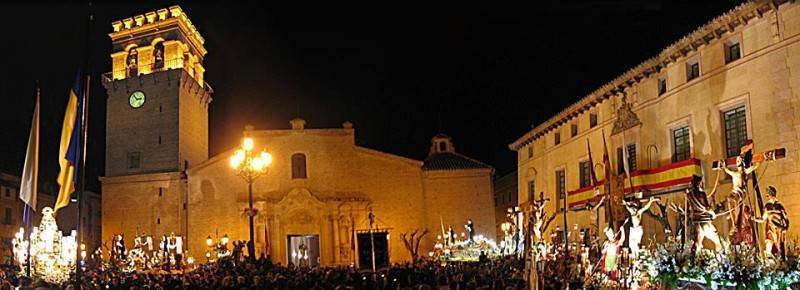
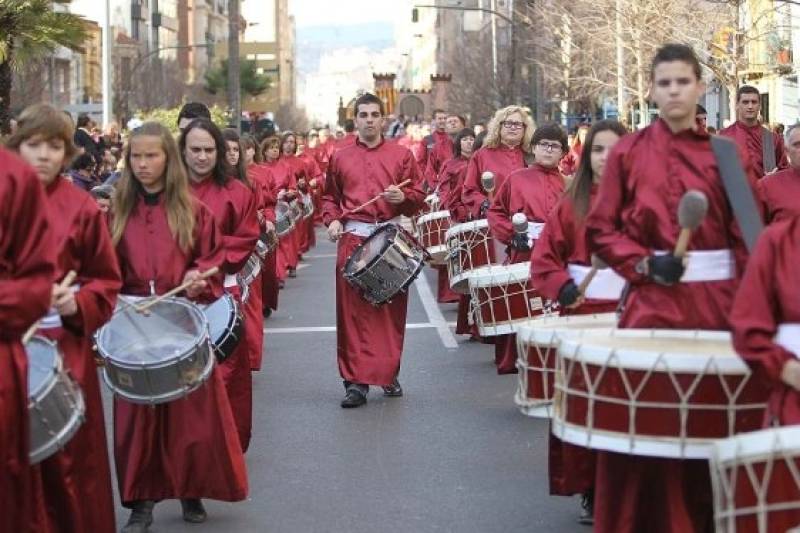
The Semana Santa or Holy Week celebrations in Totana are particularly well regarded and are among the most important of the Region of Murcia, featuring processions which date back to the 18th century. Nowadays the events are organized by 16 Cofradías (brotherhoods or guilds) who parade nearly 30 splendid figures and tableaux (“Pasos”), with the old, winding streets of the town providing a perfect backdrop.
More than 3,000 guild members don their Nazarene tunics for the processions, 390 of them being the "ladies of Nuestra Señora de la Esperanza", who wear the "mantilla" (the traditional lace headdress), rosary beads and the devotional scapular and carry walking staffs in their silent procession on the Wednesday of Easter Week.
Most of the guilds were formed during the 19th century, but in the 1930s the Civil War devastated the sculptures and tableaux of Totana. The regeneration of the Semana Santa celebrations after the War included the foundation of four new guilds, who helped to regain the splendour of the old traditions with new icons.
The tableaux dearest to the hearts of the Totananeros are the Cristo de la Agonía, the Virgen de la Esperanza, Nuestro Padre Jesús Nazareno and Salzillo’s Magdalena, which are revered all year round, not only during Easter. The most renowned processions are those on Easter Wednesday, Maundy Thursday, Good Friday and Easter Sunday, the largest being on the Thursday and Friday. The most famous artists whose works are featured are Francisco Salzillo, Lozano Roca, Carrillo, Antonio Ruiz and Sánchez Araciel.
One of the stand-out features of Semana Santa in Totana is the presence of the "Armaos". These are Roman soldiers, whose participation is always warmly applauded by the assembled crowds, and the group dates back to the 18th century, when eighteen men from the most important families in the town dressed as Romans to carry the figures of Nuestro Padre Jesús and the Holy Sepulchre in the Good Friday evening procession.
Another important aspect of Totana’s processions is the "Bocina" (siren) or "Dragón", which is carried on a trolley and sounds a sad wail during the parades.
 The music and colour of Semana Santa make this a special time to visit Totana, and if you can tie in a visit as part of your Semana Santa schedule you won’t be disappointed!
The two main locations are the Parroquia (parish church) de Santiago, which is in the main square (Plaza de la Constitución), and the Parroquia de las Tres Avemarías, in the Plaza de las Trés Ave Marías close by.
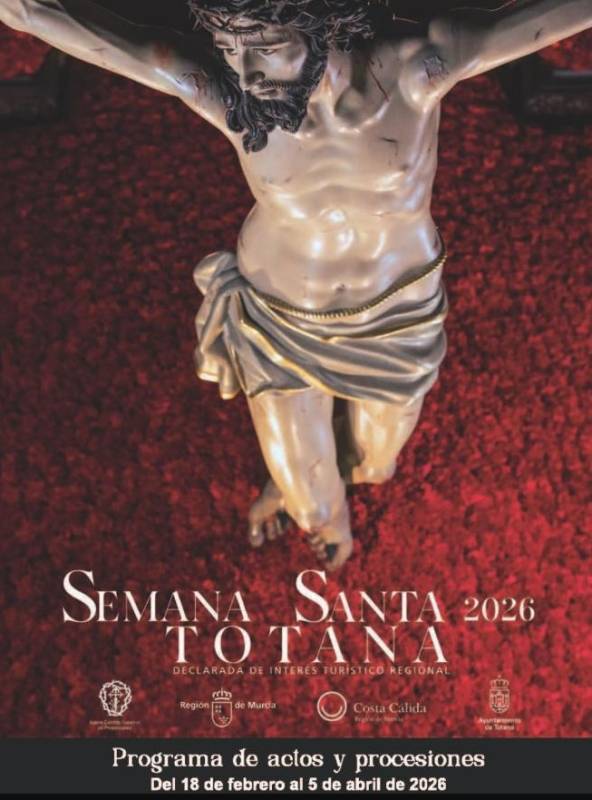
The main events in Semana Santa 2026 in Totana are the following:
Friday March 27, Viernes de Dolores (Friday of Sorrows)
17.00: Holy Mass in the Ermita del Calvario.
20.30: Vía Crucis from the Parroquia de las Tres Avemarías, with the figure of Nuestro Padre Jesús Nazareno.
Saturday March 28
21.30: Meeting of Jesús de la Humildad and Nuustra Señora de la Fe in the Plaza de la Constitución.
Sunday March 29, Domingo de Ramos (Palm Sunday)
The palm decorations sold for Palm Sunday, along with the palm and olive branches, are blessed outside the parish church, and then the procession of La Burrica and the triumphant entry of Christ into Jerusalem takes place in the streets of Totana. Jesus leads the way on a donkey and is followed by families in their Sunday best, clutching their palm decorations.
10.45: The Blessing of the Palms procession in the Plaza de la Constitución, followed by Holy Mass in the Parroquia de Santiago.
Procession route: Plaza de la Constitución, Mayor Sevilla, García Alíx, Cañada de Zamora, Avda. de Lorca, Sol, and return to Plaza de la Constitución.
There is also a second parade leaving from the little Ermita de San Roque, also at 10.45. This follows a different route, returning to the church: Ermita de San Roque, San Roque, Plaza Melchor de Benisa, Juan XXIII, Juan de la Cierva and concluding in the Glorieta del Convento.
Monday March 30, Lunes Santo (Holy Monday)
20.30: Semana Santa concert by the Agrupación Musical de Totana in the church of Santiago El Mayor.
21.00: Penitential Procession leaving the Convento de las Tres Avemarías with 3 pasos (the Ecce Homo, Cristo del Consuelo and Nuestra Señora de los Dolores). This follows a route from the Glorieta del Convento to General Páramo, Carril Tercero, Eras, Guillen, San Antonio, Juan XXIII and the Glorieta del Convento.
22.15: The platforms to carry the tableaux featured in the processions of the following two days arrive at the church of Santiago.
Tuesday March 31, Martes Santo (Easter Tuesday)
21.30: Procession leaving the parish church of Santiago in Plaza de la Constitución.
Route: Plaza de la Constitución, Calle Pilar, Calle Don José María, Plaza de Miguel Marín, Avenida de Santa Eulalia, San Antonio, Puente, Plaza de la Constitución.
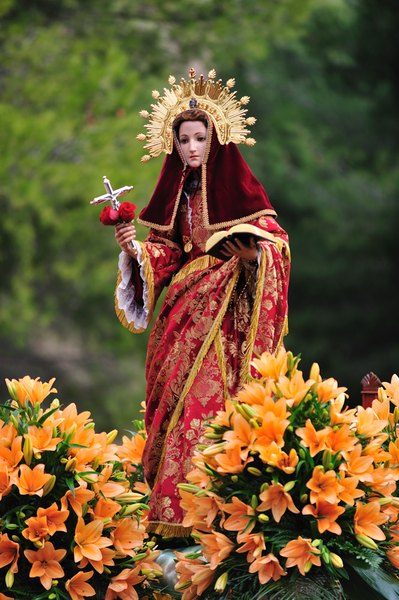
6 pasos: Ángel de la Pasión, Jesús Flagelado, Ecce Homo, Santa María Magdalena, San Juan Evangelista and Nuestra Señora de la Fe.
 Wednesday April 1, Miércoles Santo (Easter Wednesday)
22.00: Procession in silence starting at the Parroquia de Santiago, featuring the pasos of Cristo de la Agonía and Nuestra Señora de la Esperanza.
Route: Plaza de la Constitución, Puente, Antonio Garrigues, Legaz, Mayor Triana, Quintín, Cuartelillo, Juan XXIII, San Antonio, Avenida Santa Eulalia, Plaza de Miguel Marín, D. José María, Pilar, Héroe B. Cayuela, Alférez Crespo, García Alíx, San Juan, Gómez Pellicer, Salvador Aledo, Plaza Francisco Palao, Ramblar, General Aznar and concluding in the Plaza de la Constitución.
Thursday April 2, Jueves Santo (Maundy Thursday)
9.00: Handing over of the flag to the "Armaos" (Roman Soldiers) in the Plaza de la Constitución.
11.45: The tableaux participating in the evening procession arrive at the church of Santiago.
18.00: Celebration of the Last Supper in the church of Santiago.
18.30: Celebration of the Last Supper in the church of Las Tres Avemarías.
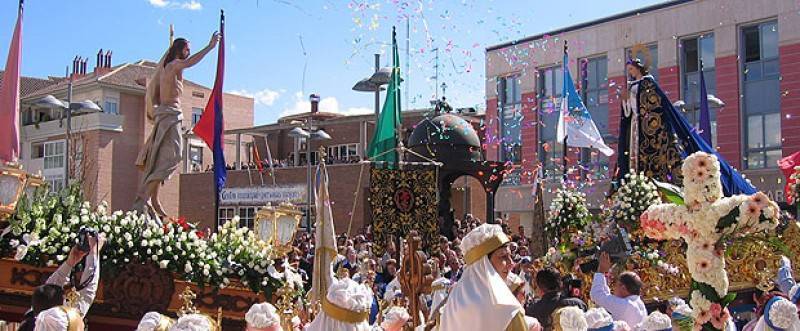
21.00: Procession of the Last Supper, featuring 14 pasos (Samaritana, Santa Cena, Oración en el Huerto, Beso de Judas, Negación, Jesús Flagelado, Ecce Homo, Coronación de Espinas, Nuestro Padre Jesús Nazareno, Verónica, Santísimo Cristo de la Caída, Santa María Magdalena and Nuestra Señora de los Dolores).
Route: Plaza de la Constitución (church of Santiago), General Aznar, Encomienda, Avenida Rambla de la Santa, Alberto Gray Peinado, Calle Padre Ángel de Novelé; Plaza de Juan de la Cierva; Calle Juan XXIII; Calle San Antonio, Calle Puente, Plaza de la Constitución.
Friday April 3, Viernes Santo (Good Friday)
10.30: Procession from the Parroquia de Santiago with 9 pasos (Samaritana, Negación, Lavatorio de Pilatos, Ntro. Padre Jesús Nazareno, Verónica, Santísimo Cristo de la Caída, Santa María Cleofé, San Juan Evangelista, and Nuestra Señora de los Dolores).
Route: Plaza de la Constitución, Pilar, D. José María, Plaza Miguel Marín, Andrés Caruana, Padre Melchor de Benisa, San Antonio, Puente, Plaza de la Constitución.
14.30: The figure of Jesús en el Calvario arrives at the church of Santiago.
18.00: Good Friday Mass in the church of Santiago.
18.30: Good Friday Mass in the church of Las Tres Avemarías.
19.45: The figure of the Holy Sepulchre arrives at the church of Santiago.
19.55: The figure of Cristo de la Sangre arrives at the church of Santiago.
21.00: Procesión del Santo Entierro, leaving from the Parroquía de Santiago.
This is one of the most important processions of the week with 14 pasos (Elevación de la Cruz, Jesús Traspasado, Cristo de la Sangre, Jesús en el Calvario, Descendimiento, Ntra. Sra. de la Caridad, Exaltación de la Cruz, Santo Sepulcro, Verónica, Santa María Cleofé, Santa María Salomé, Santa María Magdalena, San Juan Evangelista and Ntra. Sra. de los Dolores.)
Route: Plaza de la Constitución, Puente, San Antonio, Avenida de Santa Eulalia, Plaza Miguel Marín, D. José María, Pilar, Héroe B. Cayuela, Alférez Crespo, García Alix, Cañada de Zamora, Avenida de Lorca, Álamo, Cánovas del Castillo, General Aznar, Plaza de la Constitución.
Saturday April 4, Sábado Santo (Easter Saturday)
23.00: Easter Vigil and Resurrection Mass in the churches of Santiago and las Tres Avemarías.
Sunday April 17, Día de la Resurreción (Easter Sunday)
This is the morning of light and resurrection, the figure of the Holy Virgen de la Alegría leaving from the Tres Ave Marías and Jesus Arisen leaving from the Plaza de la Constitución at 10.30. Each follows its own route then they meet at 12.00 midday in what’s known as an "encuentro", to tumultuous applause - a lovely moment, full of light and flowers.
10.45: Procession of the figure of Jesus Arisen - Plaza de la Constitución, Sol, Álamo, Cánovas del Castillo, General Aznar, Plaza de la Constitución.
11.15: Procession of the figure of the Holy Virgen de la Alegría - Glorieta del Convento, Juan XXIII, San Antonio, Puente, Plaza de la Constitución.
12.00: The two processions meet in the Plaza de la Constitución, followed by a joint procession, (Plaza de la Constitución, Puente, San Antonio, Avenida de Santa Eulalia, San Cristóbal, Padre Melchor de Benisa, Juan XXIII, Plaza Juan de la Cierva).
Images: Ilustre Cabildo Superior de Procesiones de Totana
 The Tourist Information Office in Totana is in Plaza de la Balsa Vieja, having moved from its former location in the the Town hall, and is right in the heart of the older quarter of Totana, a one minute walk from the main underground carparking.
The tourist office is able to supply town maps, and information about the walking options within the Sierra Espuña and places of local interest to visit. The town has a number of churches and monuments which offer a pleasant walk with a stop-off for coffee and the weekly town market is popular with local expats.
Totana is famous for its local ceramic manufacturers, and the Tourist office can supply a list of working ceramicists and locations where local ceramic products can be purchased. These are surprisingly well-priced, and the local artesans are able to manufacture personalised designs and housename plaques to order.
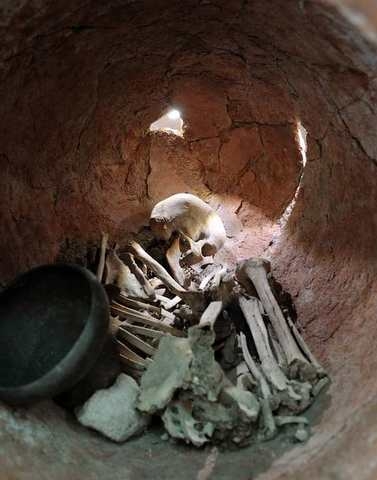 The most important tourist attraction in Totana is the La Bastida Argaric archaeological site, which can be visited by groups or individuals by prior arrangement with the tourist office.
Totana Tourist information office
Plaza de la Balsa Vieja
30850
Totana (Murcia)
Tel: 968 418 153 (calls go through the town hall, ask for the Oficina de Turismo)
Fax: 968 418 183
Totana Tourist Office Opening Hours:
From Monday to Friday 08:00 to 15:00, Saturdays from 09:00 to 14:00 and closed on Sunday
Where is Totana?
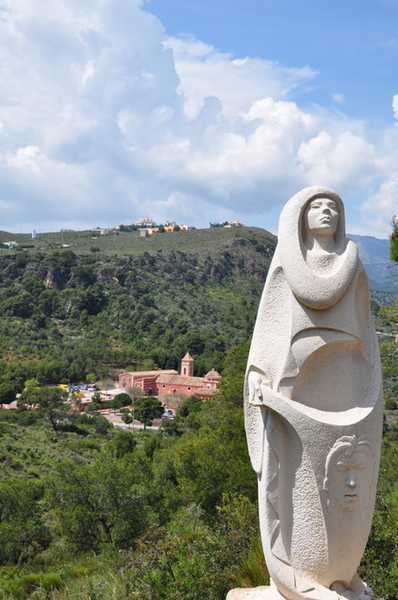 Totana is in the South-west area of Murcia, 40 minutes from the capital City of Murcia, 30-40 minutes from the San Javier airport and about 1.15 minutes from Alicante airport. It is 30km from the coast and the beaches of Mazarrón. At the foot of the Sierra Espuña, it is in the heart of the Guadalentin valley, and well connected, both by road and rail.
It borders with Mula to the north, Alhama de Murcia to the east, Mazarrón and Lorca to the south and Aledo to the west.
Click for map, Totana , Murcia